truck Toyoland - for owners of modern Toyota Corolla cars toyota cars


The Toyota minivans: Van, Previa, and Sienna

Click here for our 2005 Toyota Sienna review

1987 toyota vanLike Chrysler (and Renault), Toyota introduced a minivan in 1984; as with the Plymouth, Dodge, and Renault minis, it was powered by a four cylinder engine with a standard manual transmission. Like the first GM and Ford minis, though, it used rear wheel drive. It was unique in its mid-engined design, and optional four-speed automatic transmission, though. 

In 1984, Toyota set out to capture a portion of the rapidly  growing minivan market that Chrysler had recently created. Instead  of following Chrysler's lead, Toyota designed a "one-box" type vehicle powered by a mid-mounted 2.0L four-cylinder engine driving the rear wheels.  Advanced options, which would not arrive on competitors’ vehicles for years, were dual air-conditioners with separate controls for front and rear seat occupants, and an ice maker/cooler box. Like other minivans, it could seat up to seven people, and was offered in both passenger and cargo versions (the cargo version came in 1985). The cargo version of the Caravan/Voyager had metal, windowless sides; the Toyota Van simply deleted the seats.

Just as the original 2.2 liter carbureted Chrysler engine was too slow with an automatic, the Toyota 2.0 needed an upgrade, and received one in 1986 - to 2.2 liters (Chrysler offered a 2.6 first, then a turbo, 2.5, and finally a V6). Along wiht the new engine came a front passenger swivel seat and interior upgrades.

1987 brought a four wheel drive option, rather different from Chrysler’s all-wheel drive. A two speed transfer case was used for manual transmissions, a single-speed with automatics. Interior seating was upgraded again. Copying Plymouth’s "magic wagon" name, Toyota advertised its passenger van as Wonderwagons, but failed to give them a name less generic than Passenger Wagon. An optional Captain's Chair package, taking off of Plymouth's similar offering, gave more luxurious seating for seven, with an adjustable driver's seat and - going one step further - middle row chairs that swiveled and reclined. A cooler/ice maker could also be added, if dual air conditioning was purchased. The Cargo Van also got all wheel drive; it had over 187 cubic feet of cargo space (155 cubic feet with optional front passenger seat), a 2,020 pound payload capacity with the manual transmission, and a 2.2 liter electronically fuel injected engine. The van had a sliding side door and high-opening rear hatch.

In 1990, faced with lackluster sales, Toyota redesigned and renamed the Van, calling it the Previa (“preview”). It still relied on rear wheel drive and a mid-mounted four-cylinder (now up to 2.4 liters), and still had optional four wheel drive. The cargo version was dropped - Chrysler dropped their cargo van a year later - but now the rear seats could fold up and the center seat could be removed to accommodate large cargo, including the infamous four by eight plywood. The shape was, in Toyota's words, "designed in the U.S. for American styling tastes. Thanks to a unique space-efficient mechanical layout, Previa offers outstanding interior room, optimal weight distribution, and a low center of gravity for superior stability." This was somewhat true for 1990, when Chrysler was still selling minivans that were essentially tall Reliants [see this link], but the revised, second-generation Caravan and Voyager would be larger, more comfortable, and much better-handling, with front wheel drive and a V6, and Previa sales never seriously challenged Dodge or Plymouth. The shape also did not take off any better than the "Dustbuster" General Motors minis.
1991 Toyota Previa minivans

inside the Toyota Previa minivanFederal regulations brought safety changes in 1992, with a driver’s side airbag, side impact and rollover protection, and a center high mounted stop light. The Previa was the first minivan to meet all passenger car safety standards, a position it would hold for a brief time. A passenger airbag joined the crowd in 1994.

While a turbocharged Chrysler minivan had been available in 1989 and 1990 - displaced by a V6 - the Previa gained a supercharger in 1994, increasing power at the cost of requiring premium fuel. The Previa also gained leather seats, a CD player, and dual moonroofs.  Still, sales were only a small fraction of the Voyager and Caravan.

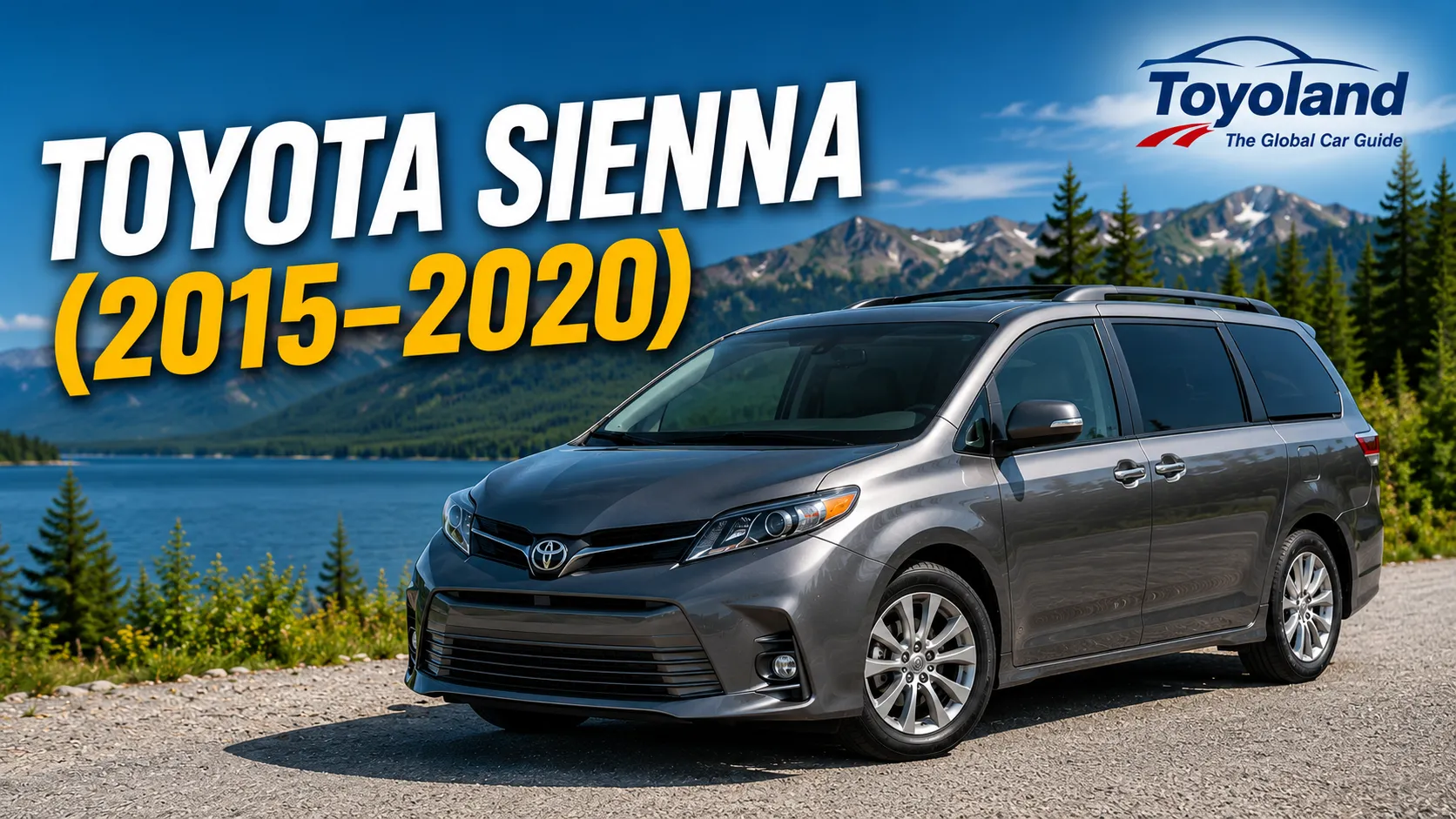
In 1998, after 14 years of watching the Van and Previa sales in the US go nowhere, Toyota introduced the Sienna (named after the color or city, your choice), which copied the Chrysler formula much more closely. It was powered by a V6, and ran on the front-drive Camry platform.  It added modular, adjustable seats with seatback trays, more cupholders, front and rear power outlets, many storage compartments, and other interior features.  ALR/ELR seatbelts were used on all outboard seats, and antilock brakes and tire pressure warning were standard. A power door was added as an option in 1999, along with dual built-in seats. The Sienna seemed to be more favored, though the Honda Odyssey, which also closely followed the Chrysler design, was more popular and became the first serious challenger to Chrysler's dominance. It didn't take long for Chrysler to lose their overall majority share.

Three years later, in 2001, the engine was worked over with variable valve technology (raising horsepower by 16 while raising gas mileage) and verified as a low emissions vehicle; and skid control was added. The exterior and interior were also freshened.

The Symphony edition appeared in 2002, with an eight-speaker JBL stereo and a wide variety of other luxury features.

The 2004 Sienna not only matched the Chrysler minis but leapfrogged them, and was made much more American - being assembled in Indiana, with 90 percent of its content sourced from American suppliers. A new chassis seems to have been designed specifically for the Sienna, with four inch wider track but three foot tighter turning radius - a foot tighter than the next best minivan. The wheelbase is five inches longer than the 2003 model. Passenger volume beats all other 2004 minivans, with a 45 cubic foot increase in interior volume. Especially appealing are split (60/40) third row bench seats that fold flat into the floor, in a rapid, single-hand movement. Again, 4x8 sheets of plywood can be put in, if the second row seats are removed.

A new V6 produces 230 horsepower; thanks to a five-speed automatic, it produces both the fastest sprints to 60 and the best mileage of any 2004 American minvian. The engine and transmission are both made in West Virginia.

Toyota Sienna owner notes

New brake pads have been designed to avoid fast wear problems on some 2004-2005 Siennas. It's part number 04465-45030. They might be a little noisier, but they wear better.

If rear passengers in 2004 Siennas and early 2005 Siennas complain that the entertainment system screen is hard to see, the dealer may be able to replace it with one that's been adjusted with a different screen position through a Panasonic exchange program. 

The computer has been upgraded on 2004 Siennas and some 2005 Siennas to improve response during heavy acceleration, reduce gear hunting from 20-30 mph, and make downshifts faster from 10-20 mph. This will only be done if you actually have problems in these areas, and takes about 1-2 hours, so don’t ask your dealer to do it if you haven't had any issues! (It's covered for 96 months or 80,000 miles.)

New wiper arms have been designed for the rear wipers of 2004-05 models. (It was introduced as a running change on 2005s to improve the rear wiper.) It's part 85241-20170 for the arm and 85212-13030 for the blade.

If a/c is lost on 2003-2004 models, the fault may be with the magnetic clutch on the compressor. A revised part is available (90987-02028).

Getting a popping noise on your 2004 or 2005 with a JBL audio system? The problem could be the amplifier staying on even though the ignition is off; it could kill your battery over time. The dealer can replace the amplifier if it happens to you. (It was fixed as a running change in the 2005 model year.)

Toyota minivan reviews

2005 Toyota Sienna

Coming soon: 2000 Toyota Sienna


Toyota forums at toyoland.com  

Custom Search


A site dedicated to Toyota cars, trucks, and minivans